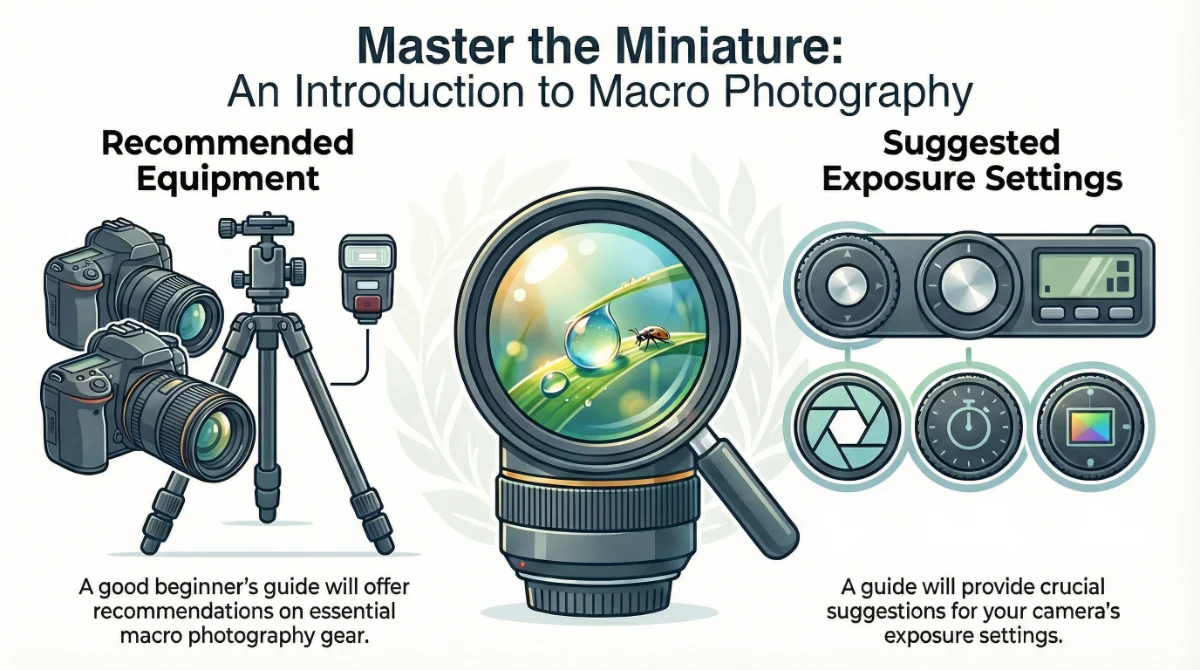
Master the Miniature: An Introduction to Macro
Have you ever looked at the morning dew on a leaf or the intricate patterns on an insect's wing and wished you could capture that hidden world? Macro photography is the art of making the small look monumental. It’s about more than just getting "close"—it’s about revealing textures and details that are invisible to the naked eye.
As a teaser for our upcoming Mastering the Micro course, here are the three fundamental pillars you need to understand to start your journey.
1. Understanding Magnification and Ratio
In macro photography, we talk about magnification ratios. A "true" macro lens offers a 1:1 ratio.
- 1:1 Ratio: This means the subject is rendered at life-size on your camera's sensor. If you photograph a 1cm ant, it takes up exactly 1cm of space on the sensor.
- Greater than 1:1: This is "extreme macro," where the subject appears larger than life-size (e.g., 2:1 or 5:1).
2. The Challenge of Depth of Field
When you get very close to a subject, your Depth of Field (DoF)—the area of the image that is in sharp focus—becomes incredibly thin, sometimes just a fraction of a millimetre.
- The Trade-off: To get more of the subject in focus, you’ll need a narrower aperture (higher f-stop, like f/11 or f/16).
- The Diffraction Limit: If you stop down too far (like f/22), you might actually lose sharpness due to light diffraction.
- The Pro Tip: Professional macro photographers often use a technique called Focus Stacking, taking multiple photos at different focus points and merging them later.
3. Light is Your Best Friend (and Biggest Enemy)
Because you are often inches away from your subject, your camera and lens can easily block the natural light, casting a shadow over your tiny stage.
- Diffuse the Light: Harsh sunlight creates "hot spots" on shiny insects or wet leaves. Using a small diffuser or even a white piece of paper can soften those shadows.
- Artificial Help: Many macro photographers use Ring Flashes or Twin Lites that attach to the front of the lens to ensure the subject is illuminated evenly from the front.
What’s Coming in the Full Course?
This is just the surface of the "tiny" iceberg. In our upcoming full course, we will dive deep into:
- Equipment on a Budget: Using extension tubes and reverse rings.
- Composition: How to lead the eye in a frame that's only an inch wide.
- Field Ethics: How to photograph insects and plants without harming the ecosystem.
- Post-Processing: Mastering the focus stack in post-processing software.
"Macro photography proves that you don't need to travel the world to find epic landscapes; sometimes, they are right in your backyard."